LLMs are a tool for class war
Intro #
Many people have written many articles about LLMs and Gen AI. On platforms like Hacker News, Reddit, or lobste.rs, every day yields a new crop of articles that claim either that LLMS have rendered a whole type of work obsolete or that they don’t work that well actually. Most of the conversations focus entirely on how good (or bad) those new tools are. I argue that whether the LLMs work or not is a distraction. It doesn’t matter if they work. Instead there are three very salient reasons to refuse to use them:
- Their environmental impact is dreadful at a time where software engineers, as a profession, need to make software more efficient to safeguard the environment.
- They rely on the underpaid labor of workers in 3rd world countries and stolen copyrighted materials.
- They are the latest tools for a class war against the middle class and white collar work.
In this piece, I’ll focus on the third point. I argue that LLMs are a tool for mechanisation and (try to) demonstrate that mechanisation is about reducing workers’ negotiation power in the workplace and not about efficiency, at the cost of the quality of the produced goods and workers’ livelihoods.
The nature of work and automation #
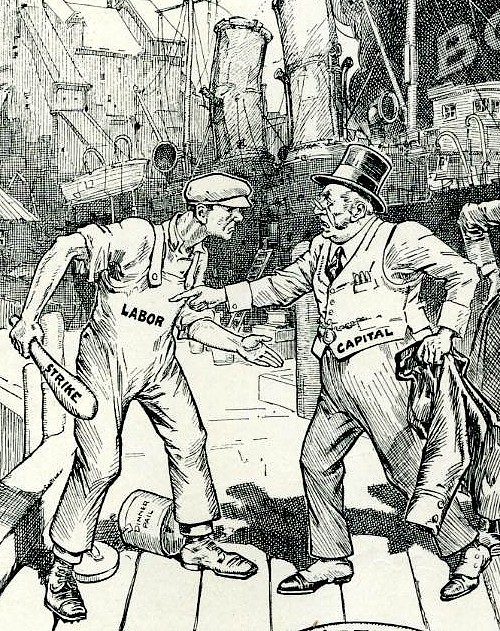
Capital and labor #
Neo-classical economics teaches us that a “factory” takes in “capital” and “labor” and outputs “goods” (of the physical or service kind). The distinction between capital and labor can be contested, but broadly “people” are usually considered labor, and the rest is capital. In this model, your factory produces an output that is proportional to its labor and capital inputs. No computers to type on, and the software can’t be written. No engineers to type on the computers, and the software also can’t be written. But if you spend correctly on both in the right measures, you maximize your outputs.
In practice, the important distinction between capital and labor is that labor is alive and has its own opinions. This means, if you treat it badly, it can sue you, or (worse even?) refuse to work. As such, it would be very nice for the factory if labor behaved more like capital. But someone still needs to do the work.
Work and meta-work #
To replace labor, it must first be isolated from its decision-making needs. The main way to achieve this is by neatly separating work between “vision” - or meta-work - and “enactment” - or work. Typically, company founders and other flavors of CEO provide vision while they employ people to enact it. Of course there can be an entire managerial class across whom the vision is delegated, and so in a sense there are layers of vision and of enactment. Every era of automation is an attempt at removing the meta-work from one of those layers, further alienating the workers from their decision-making and consolidating political power.
Organizing work and deciding on what needs to happen is real work. What I refer to as meta-work is more specifically the organisation of and power over those decisions. The further removed from using your hands (even to type your own emails), the more meta the work, the more power you have, the less you can be automated.
One example from software engineering of trying to extract the meta-work from the worker is Jira (or Monday/Asana/Basecamp, pick your poison), a ticketing system for organizing work. Jira allows for a variety of workflows, but a common one would be where managers create tickets (work items), and engineers complete the tickets. One of the key promises of such software is that if you do the meta-work correctly and arrange the tickets just right, then the engineers become fungible, and any engineer can take on any ticket. Ironically, the act of writing a specification for a task to such a degree that it can be portably performed on a variety of platforms is what we call software engineering. This is but one example where meta-workers try to replace work with meta-work.
The above workflow might seem like an exaggeration, but I have heard first-hand of multiple start-ups where only the (non-technical) CEO was allowed to create or delete Jira tickets. For meta-workers, the perfect company is the one where the CEO speaks and their will is made manifest unto the world.
Automation is the promise of that power. Further using the tech industry as a case study, we already have two past trends that tried to achieve this. The first one was so-called “no-code”, wherein GUIs that anyone could use would allow people to build websites, construct back-ends, and even perform complex analytics at scale. The second one was “off-shoring”, wherein company A (usually in the global North) would spend capital to hire company B (usually in the global South), trying to pass company B’s labor costs as capital costs for company A. Both of these failed to some degree: we still employ engineers in high cost-of-living countries. “No-code” because if your problem becomes very complex, eventually you need to go modify the code internals directly. Offshoring because physical and cultural distance, added to a revolving door of contractors, tends to generate poor outcomes for any work. They both succeeded massively in some other regard: make workers believe their skills weren’t valuable any more and devalue their negotiating power.
Still in the tech industry, but affecting non-tech workers, the most salient recent example is uberization. In effect, Uber (and Airbnb and others) created platforms on which to build markets of buyers and sellers: of car rides, of home stays, etc. The fundamentals of those industries were unchanged by the new platforms, but technology was used as an excuse to appropriate the meta-work. Your business isn’t being a chauffeur, it’s being an uber driver. Your business isn’t a Bed&Breakfast, it’s managing an Airbnb.
LLMs and GenAI inscribe themselves exactly in the lineage of automation transformations that promise to swap labor for capital to weaken labor rights.
LLMs: new paint, old threat #
Code as process #
The role of software engineer has an almost mystical aura: you can make the computer do things, and if the computer does things just right, you get Apple, or Google, or some other worldwide monopoly. But what does a software engineer do conceptually? What is code? In essence, code is process. A common task in a lot of white collar jobs is to follow a set of instructions to transfer some numbers from one spreadsheet to another, or to update a set of PowerPoint slides on a weekly basis with some updated charts. A lot of what software can do is take these tasks and mechanise them. The irony that now this very task is at risk of mechanisation is not lost on me.
But software can mechanise tasks to such a degree of abstraction that it enables a whole new class of processes. Processes that are so burdensome that they never would have been born otherwise. One good such example is computer graphics. Showing a picture on a computer monitor means that for every frame (ideally 60 per second), someone needs to decide what color appears in each one of the hundreds of thousands of pixels that make the monitor. Imagine a painter painstakingly performing hyper-realistic pointillism in real time. Without the process(ing) speeds of computers, such a task is simply nonsense.
Before excel spreadsheets, financial institutions had departments make large sheets of tables by hand to be filled by accountants. Before word documents (and LaTeX before that), typesetting a page required physically arranging printers. Before LLMs, writing code required typing on a keyboard. But the difficulty was never in writing the code, or drawing the spreadsheet, or arranging the printing blocks. It was always in knowing what code to write, which spreadsheets to make, and what to print.
In fact, besides the code they write, software engineers also have to manage the human side of their role. Someone wants to do something, and they have to understand the business problem if they want to formalize its process into code. Once that’s done, they have to continuously update the code to match the changes in process.
The main difference between those who write code and the mechanised proletariat is that it happened to the others first.
LLMs are compression engines #
The world model of LLMs is a complex surface that represents the totality of the Internet, plus or minus every book ever digitized and some curated data. However, whereas the Internet is on the order of <200 Zetabytes, the largest LLMs are on the order of <200 Gigabytes, a 10^12 difference in orders of magnitude. In that framework, hallucinations are akin to compression artifacts. LLMs are a method for (lossy) compression.
The most striking difference with other compression algorithm is that you don’t “unzip” the LLM. You ask it a question in natural language, which gives you access to a specific part of its world representation. Arguably, the LLM’s verbosity is a form of decompression: from the parameters to the tokens to natural language sentences.
To mechanise white collar work, the entire collection of human creation available online was compressed to be regurgitated on demand. It is no accident that this mechanisation is intellectual property theft.
Which work is safe? #
All work is knowledge work #
Recently (Drucker, 1959) the concept of “knowledge work” has entered the global lexicon. The idea is that if you mostly use your brain and need a college degree for your job, then it is knowledge work. And for years everyone has been advocating that those are the most prestigious jobs to have.
Anecdotally, I work in quantitative finance, a field famous for its difficulty, and I’ve met people who are both at once: convinced that they can download a stock broker app on their phone and make a fortune; and also that my job looks really hard. However, when I see a team of people build a house from scratch, I’m under no illusion that I could do it myself. I would need extensive training and oversight, and the first few attempts would probably be so bad as to be hazardous. Their work takes knowledge and I don’t have it. Manual laborers need to know about materials, a whole host of techniques and tools, and many other things I am probably missing. We also readily admit that years of experience, care, and dedication to one’s craft, all markers of increased knowledge, make for a better manual laborer. Whether a worker goes to university or not, knowledge is still an essential part of any work. The idea that there exists work that requires less knowledge is absurd to the point of classism.
But the idea that knowledge workers are “special” in some way has been instrumental in eroding our labor protections. What does it matter to have laws to protect you when your skillset is in such high demand you can just walk across the street to ask for another job?
Call me a Luddite #


The real difference between today’s software engineer and the weavers of yore is that of which knowledge has been mechanised first. For centuries, guilds and other such groups of masons, carpenters, weavers, and other knowledge workers kept their methods secret. The goals were broadly twofold. First, to make sure they could control, to some extent, the quality of what gets made in their name, and to bring a level of standardization. Second, maybe more importantly, they understood that this protected their livelihoods.
The most famous example of the revocation of this protection is probably that of the Luddites. They were 19th century English textile workers who fought against the introduction of automated machinery in their factories. At first, they tried to work with the machines, but they were used to justify cutting corners on quality and either paying workers less or outright firing them. In a form of intellectual property theft, mechanisation allowed the knowledge to move from a labor expenditure to a capital expenditure. The machine encodes knowledge “well enough” and so the worker is no longer needed for their knowledge.
Crucially, knowledge is still needed to operate the machines. In fact, many economists will argue that the introduction of machines changes the type of work done, and so far has transformed economies such that they create more jobs than they destroy. But this isn’t the point. The point is that what mechanisation really enabled is the destruction of the previous social contract: the weavers are no longer knowledge workers, so they don’t deserve the privileges associated with high status. Only the owner of the machine conserves their status. Only the meta-workers conserve their status. Eventually, the logical conclusion of such a process isn’t more and better products for the masses. On the contrary, once the knowledge is mechanised, the process must necessarily become bastardized because meta-work can never be as precise as work, otherwise it wouldn’t be meta. The end game of this mechanisation is Shein, clothes known to self-disintegrate on their first wear.
Mechanisation, in this context, is not just the transformation of a labor process from one performed by human hands to one performed by mechanical hands. It is the process of transforming labor into capital, by exteriorising a worker’s knowledge into a machine. The end goal is to deny the worker their due. Once again, the true distinction between knowledge workers and other types of workers is who has managed to protect against the mechanisation of their knowledge until now.
Negotiation is an asymmetric game #
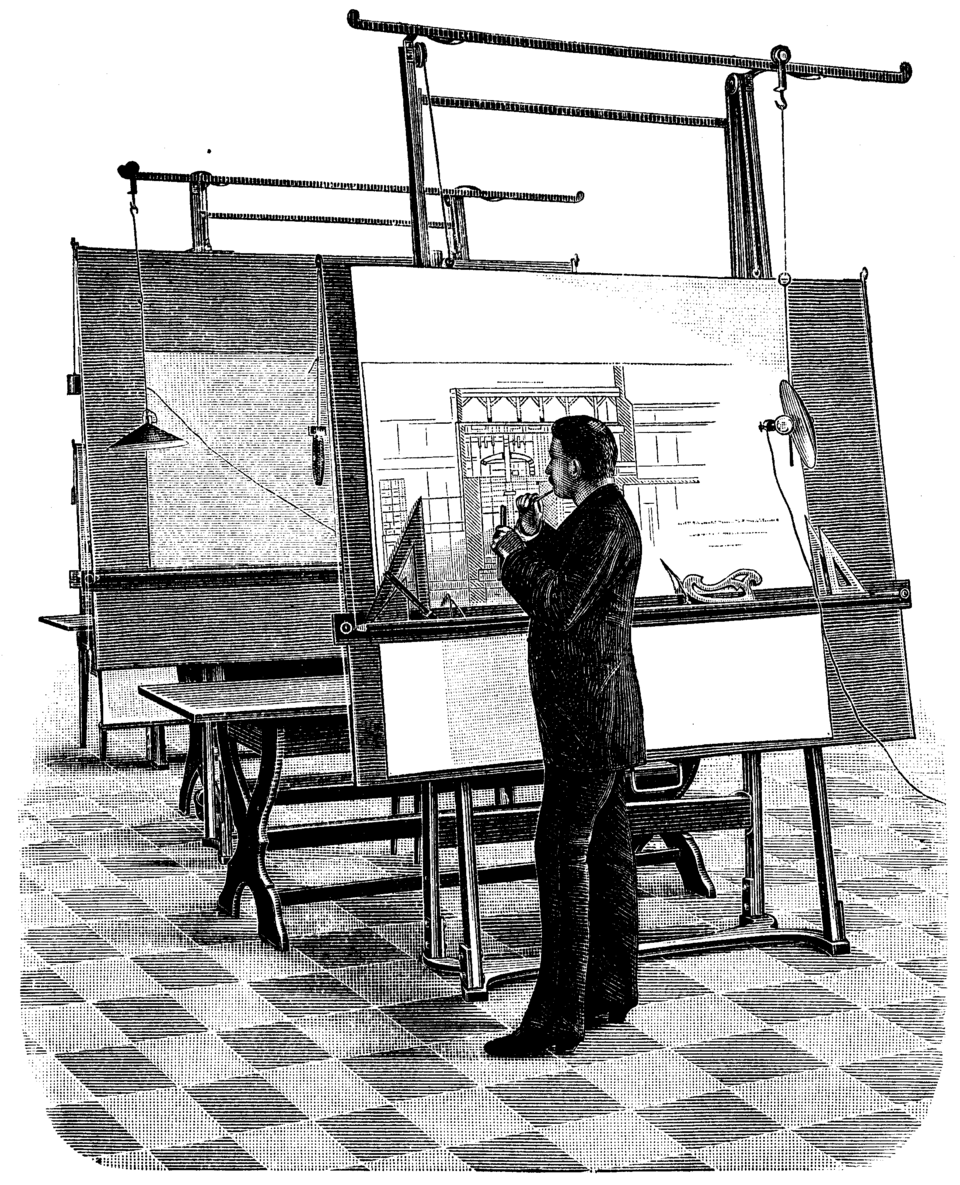
Looking at examples of knowledge workers online we see lists comprised mostly of people whose jobs demand a high number of years of study in schools: “ICT professionals, physicians, pharmacists, architects, engineers, mathematicians, scientists, designers, public accountants, lawyers, librarians, archivists, editors, and academics, whose job is to “think for a living”.” Classical economics tells us this induced scarcity is the main reason why these jobs are so well-paid. In reality however, what has kept salaries high is the ability these workers have to negotiate. Whether that ability to negotiate comes from scarcity due to the cost of long studies, or from guilds protecting knowledge, is irrelevant. Only the negotiating power matters.
For a long time, the belief was that a lot of these roles were safe from mechanisation, because thinking machines seemed like science fiction not so long ago. Since the introduction of ChatGPT in late 2022, there is now strong evidence that mechanisation comes for us all. Not because LLMs can do our jobs well - remember the Luddites and the machines which couldn’t match their quality standards - but because they offer the opportunity to attack the social contract of our roles. You are no longer a lawyer, instead you review and tweak contracts written by an LLM. You are no longer an architect, instead you review and tweak blueprints drawn by an LLM. I can’t speak to other professions, but friends tell me the following is true in across their chosen fields: reviewing work done by an LLM is orders of magnitude harder than writing it in the first place (probably a corollary of Brandolini’s law - the bullshit asymmetry principle).
Debates around whether or not LLMs can produce work of the same quality as humans are missing the point. Mechanisation need only have the pretense of quality to such a degree that it can shatter the previous organisation of labor, shatter the negotiation power. Usually the standard of quality to achieve this is lower, and so LLMs don’t need to be good, or thinking, or sentient, to be used to lower our salaries and slash our jobs.
The work still needs to be done, but now we don’t have to be paid or respected for it.
LLMs as engines for meta-work #
The promised workflow to meta-workers is as follows: write (or speak even) your command and it is enacted. Finally, the perfect employee.
Stories of the failures of those perfect employees litter the Internet. Here are some of the higher profile ones:
- An LLM wrote a hit piece on a matplotlib maintainer
- An LLM deleted an AI “alignment” researcher’s inbox
- Prompt injections and forced clawdbot installations as a supply chain attack Maybe at scale, human employees commit similar mistakes in similar proportions. Maybe LLMs are uniquely worse than people and are creating a new class of cybersecurity attack vectors and workplace mistakes.
But the decision to automate work isn’t one that depends on whether the task can be automated or not. As explained earlier, it hinges on which meta-work must be appropriated to remove the worker’s negotiation power.
It might seem contradictory, but it is precisely because meta-work is easy and because work demands effort that the former is praised while the latter is devalued. The skills of the lowers must be constantly devalued to justify their station in society.
LLMS and (neo-)colonialism #
Shein underpays factory workers in the global South and makes them work at ungodly rates to produce plastic garments that barely hold together. OpenAI and Meta have been found, multiple times, to be using workers in several African countries to moderate the content on their platforms. Constantly reviewing violent and illegal material, or labeling model outputs to ensure only the more palatable ones make it to their intended audience in the global North. Back in the day, Google had people review web pages manually to give them quality rankings to enable their page rank algorithm. Amazon sells, today, the MTurk service. You get to pay for people in a third world country to label data for you. And what does MTurk stand for you ask?
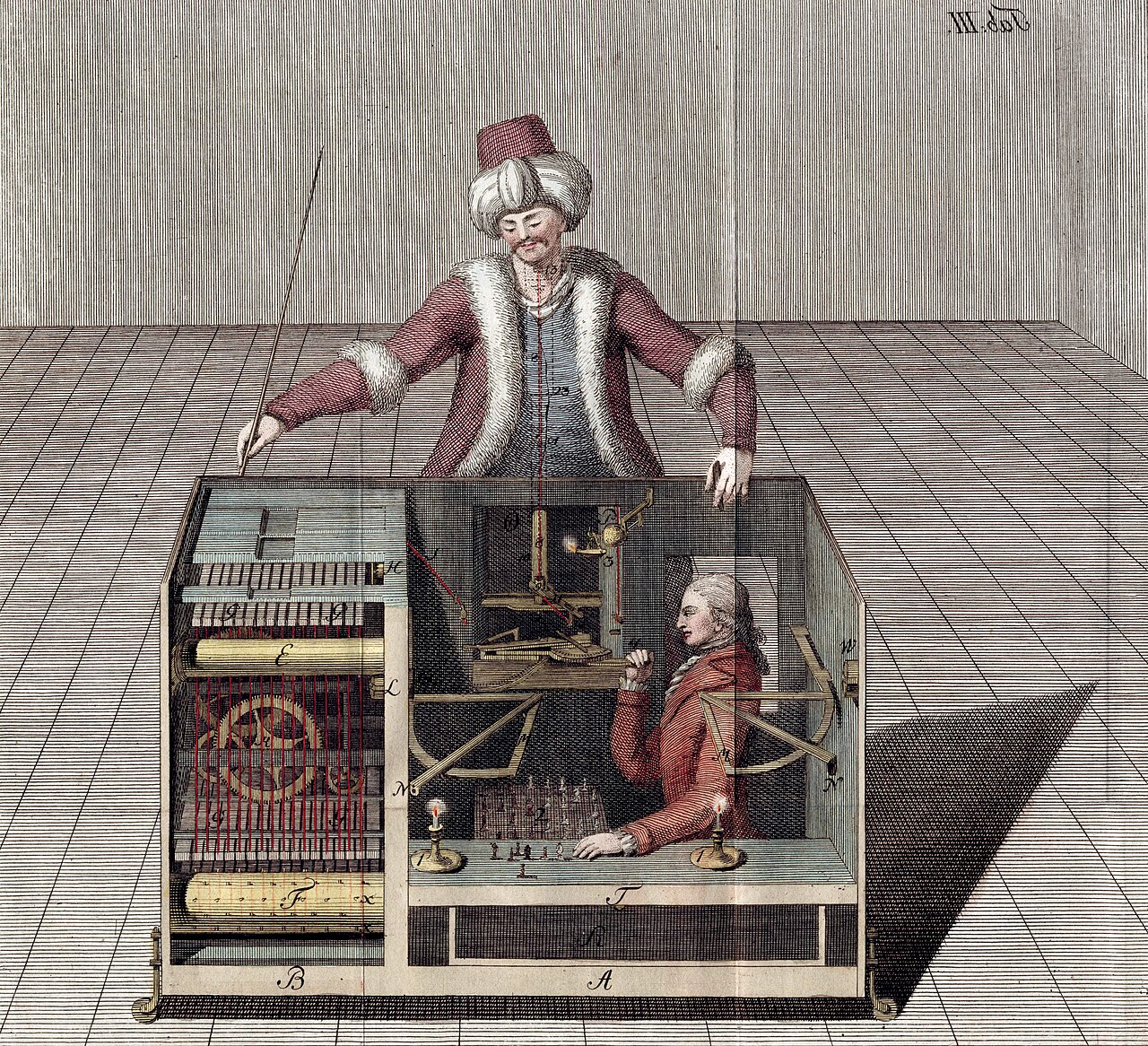
The mechanical turk is the famous story of a magical chess box in the 1800s that went around Europe challenging masters, and sometimes winning. It was presented as a marvel of technology of mysterious origins (hence the “exotic” Turk moniker) until it was revealed to be a man hidden in the box playing. A hoax. The myth of automation is that no one is doing the work anymore. The reality is that others, less fortunate, are. Whether in a box or in the global South, out of sight, out of mind.
What now? #
Amazon recently had a townhall about how LLM-generated code has caused issues. This is not the correct framing. If an engineer arranges a machine to write, commit, and review the code, then that’s the same as the engineer doing it. If the engineer’s manager writes, commits, and reviews the code, then that’s the same as them doing it. At the end of the day, we are the ones who have to take responsibility for the work produced in our name. Thinking or unthinking machine, people write, commit, and review the code. The real story about what happened at Amazon is that they reduced their engineering standards. If every piece of code wasn’t reviewed and tested like before, then the issue isn’t LLMs, it’s the engineering culture that lets subpar work make it into production.
This is a story about software, but I would suspect every other field is the same. We are seeing more and more ads made with generative AI, as well as seeing stories of law firms hallucinating cases in their legal documents. This crisis of quality is something we can all have an impact on.
Someone sends you a confusing mess of an LLM-written email? Ask for clarification. You are assigned a code review with LLM-generated code that makes no sense? Point out every line that makes no sense and condemn the architecture. You have to produce art twice as fast using an image generator? Make it (or better yet refuse) and highlight how bad the art is.
Bosses and managers won’t hear the first, second, or even third complaint. But if we keep highlighting that the quality of the work is bad and that the business will lose revenue over this, eventually they will either listen, or have to close shop.
Other avenues for convincing people LLM usage in a business setting is a bad idea:
- Changing APIs with bad versioning means workflows can’t be consistent
- Insecure business fundamentals means the tools might be gone soon
- Token costs are likely to jump overnight
- Copyrighted materials can open up the company to legal trouble
- Argue from case studies that it’s not actually cheaper or faster
When push comes to shove, the only thing that will protect you is to band together and unionize. Do it now while you have negotiating power.
Conclusion #
LLMs as a technology do interesting things: a lossy compression algorithm that you can query with human language. But instead of focusing on the technology, I would like you to focus on how it is being used to redefine our social relationships. They pretend to sell the dream that you can speak your will and make it manifest. In reality, they sell the ability to redefine who owns the fruits of your labor.
Such promises are not new in the history of automation, and they usually lead to worse conditions for workers and to worse products for consumers. Running LLMs burns the planet, makes us poorer, and hide the actual labor that went into their training set and into moderating their outputs. I won’t use them, and neither should you.
An aside on creative work #
On the Wikipedia page for knowledge workers, as of this writing, there is a helpful header on the page which states “not to be confused with creative worker”. I find this distinction interesting to make. Many engineers and lawyers and (yes even them) accountants will tell you that they think their jobs require creativity. Plenty will also tell you their jobs don’t, but it’s enough that some do. Is there something uniquely creative to musicians, painters, dancers, and other artists? Are they protected from mechanisation? These jobs are firmly rooted in the category of “what makes us human” in a way that is hard to mechanise, but attempts like Suno (AI music) or the Metaverse (2nd life but bad) are trying to accomplish just that. I highly recommend Adam Neely’s great video on the topic.
An aside on copyright #
Traditional economics teaches us that workers should be getting paid the marginal value of their labor. This is not how people are paid at all in practice. On the topic of compensation and mechanisation, an key feature is that the knowledge is encoded into the machine once, and so the “labor” fee is paid only once (when purchasing the machine). The SaaS business model (and its hardware derivatives, like denying the right to repair) is an attempt at making you pay multiple times, but that’s besides the point. The point is that mechanisation always functions by taking someone’s knowledge and encoding it such that they can no longer price that knowledge.
Hollywood sets an interesting precedent: if you’re unionized, you are usually entitled to residuals. Every time the show you were on plays, you get a check in the mail. Imagine a digital artist who gets paid every time their art is rendered. Or a programmer who gets paid every time their code is run. This organisation recognizes that just because someone did the work once doesn’t mean the work only generates value once. And that if your work generates outsized value later on, you should see some of that value.
When I bring this up, I am usually called a utopian. I encourage you to join me to dream of a fairer world.